Before December 2025, if you’d asked me what Guillain-Barré Syndrome was, I probably would have looked at you blankly.
I’d possibly heard of it. Maybe.
But GBS? No idea.
Fast-forward to now and I can talk about nerves, plasma exchange, IVIG and nerve regeneration like they’re completely normal dinner-table conversation.
Funny how quickly life can change.
Since getting sick, I’ve had so many people ask me:
“But what actually is Guillain-Barré Syndrome?”
So rather than give you a massive medical explanation that will probably put you to sleep, I’m going to explain it the way I understand it now.
Basically, my immune system attacked my nerves.
That’s the simplest way I can put it.
GBS is a neurological condition where your immune system mistakenly attacks your peripheral nervous system — basically the nerves carrying messages between your brain, spinal cord and the rest of your body.
Think of your nerves like electrical cables.
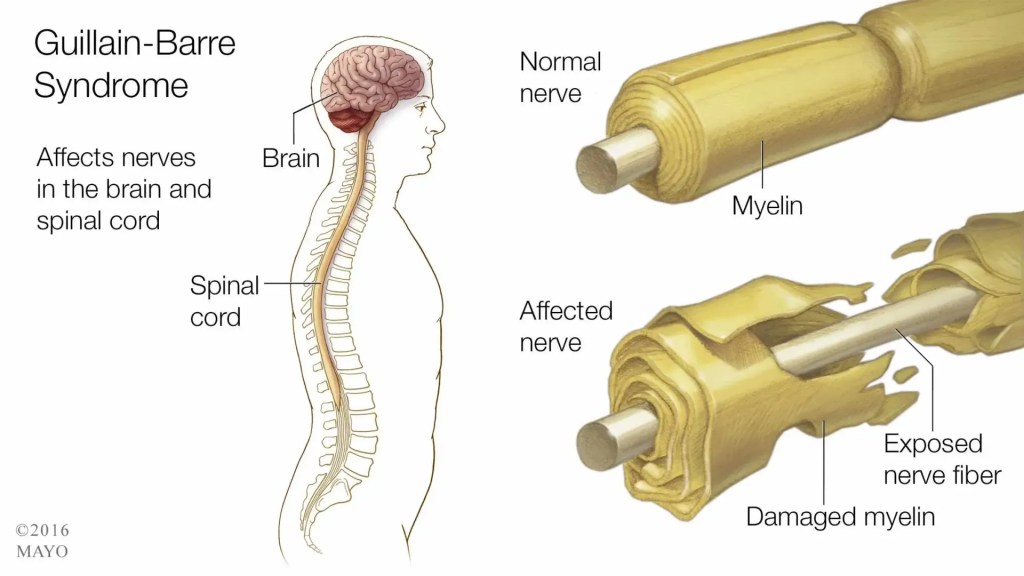
Your brain says:
Lift your foot.
The message travels down the cable.
Your foot lifts.
You don’t think about it. It just happens.
With GBS, those nerves become damaged and suddenly those messages don’t travel properly.
So your brain is still saying:
LIFT YOUR BLOODY FOOT.
And your foot is basically saying:
Yeah… nah.
😂
That’s obviously a very non-medical explanation, but after experiencing foot drop, it’s probably the easiest way I can describe what it actually feels like.
Depending on how badly the nerves are affected, GBS can cause tingling, numbness, pain, weakness, difficulty walking and paralysis.
In severe cases it can affect swallowing and even the muscles needed to breathe.
And that’s when GBS becomes very serious, very quickly.
So why did my immune system do this?
This was one of my biggest questions.
Why, after 40 years of being perfectly happy with my nerves, did my immune system suddenly decide:
Right. Let’s attack those.
GBS often happens after an infection.
There are several infections known to trigger it, including gastro bugs, influenza, Epstein-Barr virus and Cytomegalovirus (CMV).
CMV was my trigger.
Before all of this, CMV meant absolutely nothing to me.
It’s actually a really common virus. Plenty of people get it and don’t even know they’ve had it.
My body, apparently, decided to take a slightly more dramatic approach.
I contracted Cytomegalovirus (CMV) and my immune system responded to it.
Except somewhere along the way that immune response became confused and started attacking my peripheral nerves as well.
And hello, GBS.
It’s still pretty crazy to think that a virus I knew absolutely nothing about could set off a chain reaction that changed my life so dramatically.
What about vaccines?
I want to mention this because vaccines do come up when you start researching GBS.
And there has actually been a lot of research and monitoring around this — including here in Australia.
GBS has been associated with certain vaccinations, although the level of risk varies depending on the vaccine.
One of the best-known historical examples was the 1976 swine flu vaccination program in the US, where an increased number of GBS cases was identified.
More recently, Australia closely monitored GBS during the COVID vaccine rollout.
The Therapeutic Goods Administration (TGA) investigated reports of GBS following vaccination rather than simply assuming that because something happened after a vaccine, the vaccine caused it.
Interestingly, in 2021, ATAGI reported that two fatal Australian cases of GBS following the AstraZeneca COVID vaccine had been independently reviewed by an expert Vaccine Safety Investigation Group and assessed as likely to be vaccine related.
The Australian Immunisation Handbook also specifically discusses GBS and vaccination and gives additional guidance for people who have previously developed GBS within six weeks of receiving a vaccine.
So yes, the connection between vaccination and GBS is something that has been — and continues to be — studied and monitored in Australia.
But it’s also important to understand that a medical event happening after vaccination doesn’t automatically mean it happened because of the vaccination. That’s exactly why these cases are investigated.
For me personally, vaccination wasn’t the trigger. Mine was CMV.
GBS can move FAST.
This is probably the part I want people to understand most.
GBS isn’t necessarily something that slowly develops over months.
It can move frighteningly quickly.
You can go from living your completely normal life to suddenly realising something is very, very wrong.
Symptoms can include weakness, pins and needles, numbness, loss of reflexes, difficulty walking, facial weakness, swallowing problems, pain, breathing difficulties and paralysis.
And then there’s one symptom I don’t think gets talked about enough.
THE PAIN.
Oh. My. God.
The pain.
When you Google GBS, you read a lot about weakness and paralysis.
But I don’t think I was remotely prepared for how painful it could be.
I’ve talked about this in my First 72 Hours because it’s something I’ll never forget.
I’ve always thought I had a pretty high pain tolerance.
I’ve given birth to two children, done long day hikes, pushed my body through years of fitness training and competitions and generally been someone who can just get on with things when they hurt.
This was different.
I couldn’t breathe through it.
I couldn’t push through it.
It completely consumed me.
And at that point, I still didn’t know what was happening to my body.
And GBS isn’t just about your legs.
This is something else I didn’t understand initially.
GBS can affect the nerves involved in breathing and swallowing and can mess with things like your heart rate and blood pressure.
Some people become so weak that they need a ventilator to breathe for them.
So when you’re in hospital with GBS and they’re constantly checking your breathing, blood pressure, heart rate and strength, there’s a reason.
Things can change quickly.
I came frighteningly close to being intubated myself.
That part of my story deserves its own post.
How do they treat it?
There are two main treatments you’ll hear about with GBS.
IVIG — Intravenous Immunoglobulin
I had IVIG and my body didn’t respond
and
PLEX — Plasma Exchange.
I had PLEX.
And if you’re thinking:
“What the hell is plasma exchange?”
Don’t worry.
So was I.
In very basic terms, they take your blood, separate out the plasma, remove it and return your blood cells with replacement fluid.
The aim is to remove the antibodies and immune components involved in attacking your nerves.
My very scientific explanation:
Take the bad stuff out. Put the good stuff back in. Repeat.
😂
There is obviously a lot more science behind it than that.
PLEX became a huge part of my hospital journey, particularly because of how quickly I was deteriorating and how strongly I pushed for treatment.
I’ll write separately about that experience because it’s probably one of the biggest parts of my GBS story.
Then you get better… right?
This is the bit I’m still learning.
You survive the scary part.
You leave hospital.
You start walking.
Everyone sees you walking and thinks:
She’s better!
Unfortunately, GBS doesn’t really work like that.
Stopping the immune attack doesn’t magically repair the nerve damage that has already happened.
Nerves need time to recover.
Muscles need rebuilding.
Balance needs retraining.
Endurance needs to come back.
And then there’s the fatigue.
The bloody fatigue.
That’s probably one of the hardest things for me personally because before GBS, if my body wasn’t strong enough to do something, my answer was simple:
Train harder.
Do more.
Get stronger.
GBS doesn’t care about that mentality.
You can’t out-train damaged nerves.
Believe me.
If I could CrossFit my way out of GBS, I’d have been cured months ago.
“But you look fine.”
Ahhh.
My favourite.
😂
And honestly, I understand it.
If you see me walking around, taking my kids somewhere, working for a few hours or sitting having coffee, I probably do look fine.
What you don’t see is what happens afterwards.
The fatigue.
The physio.
The hydrotherapy.
The exercises.
The rest.
The weakness.
Or me concentrating on something as ridiculous as whether my big toe is clearing the ground when I walk.
Before GBS, I never once thought:
Lift foot. Clear toe. Heel down.
Why would you?
Your body just does it.
Until one day it doesn’t.
And suddenly getting your bloody toe off the ground feels like winning an Olympic medal.
That’s the strange world of GBS recovery.
So… what is GBS?
The proper medical answer is:
Guillain-Barré Syndrome is a neurological condition where the immune system mistakenly attacks the peripheral nervous system.
My answer?
GBS is discovering just how incredible your nervous system is because suddenly the things you’ve done automatically your entire life don’t work properly anymore.
It’s going from being fit, strong and completely independent to celebrating the fact that your toe moved slightly better today than it did last week.
It’s frustrating.
It’s frightening.
It’s fascinating.
And sometimes it’s completely bloody exhausting.
But every little improvement means something.
A stronger step.
A little more movement.
A bit more energy.
My foot behaving itself.
My toe actually listening to me for once.
Things I wouldn’t have even noticed before now feel like huge wins.
And that’s the part of GBS I’m living now.
One nerve, one muscle and one tiny win at a time.
A quick note on my sources
Everything about my experience is obviously just that — my experience.
But when I’m talking about the medical side of GBS, I want to make sure I’m sharing reliable information rather than something I’ve found floating around on Facebook.
For anyone who wants to read more, these are some of the sources I’ve used:
Healthdirect Australia — Australian information about GBS, symptoms, treatment and recovery.
https://www.healthdirect.gov.au/guillain-barre-syndrome
Australian Immunisation Handbook — Australian Government clinical guidance, including information about GBS and vaccination.
https://immunisationhandbook.health.gov.au/contents/vaccine-preventable-diseases/influenza-flu
Australian Technical Advisory Group on Immunisation (ATAGI) — Australian vaccine-safety updates and investigation of GBS cases.
https://www.health.gov.au/news/atagi-update-following-weekly-covid-19-meeting-22-december-2021
Therapeutic Goods Administration (TGA) — Australia’s medicines regulator and vaccine-safety monitoring body.
https://www.tga.gov.au/
World Health Organization (WHO) — Guillain-Barré Syndrome fact sheet.
https://www.who.int/news-room/fact-sheets/detail/guillain-barre-syndrome
National Institute of Neurological Disorders and Stroke (NINDS) — detailed information about GBS, nerve damage, treatment and recovery.
https://www.ninds.nih.gov/health-information/disorders/guillain-barre-syndrome
This blog is about my personal experience with Guillain-Barré Syndrome. I’ve included reputable sources for the medical information, but everyone’s experience with GBS is different and this isn’t intended to replace medical advice.


Leave a comment